Top 10 Best Risk-Based Vulnerability Management Tools in 2026 [Ranked & Scored]
7 min read
Risk-based vulnerability management exists because severity lies: most CVSS criticals are never exploited, and the handful that matter hide among thousands that don’t.
RBVM re-ranks by exploitation evidence, asset criticality, and reachability and the honest market now includes native scoring inside scanner platforms, aggregation layers above them, and exposure-math engines beside them.
One count note: our sheet listed Tenable twice (VPR and the Vulcan Cyber acquisition), so we rank nine vendors honestly.
Tenable takes 1; Qualys and Cisco Kenna complete the podium.
Key Takeaways
• 1 overall: Tenable VPR scoring plus the absorbed Vulcan Cyber orchestration lineage, counted once.
• Podium: Tenable, Qualys TruRisk (platform-native scoring), Cisco (Kenna lineage the discipline’s pioneer).
• Honest count: nine, not ten Tenable’s two sheet entries consolidated.
• 2026 theme: ADR-adjacent aggregation ArmorCode/Brinqa/Nucleus-class layers unify scanner, cloud, and appsec findings into one risk-ranked, owner-routed queue.
How We Scored (Methodology)
Research-based evaluation; no lab testing, no paid placement; editorial scores excluded from structured data.
Criteria: scoring transparency (decomposable factors), exploitation-intelligence quality, asset-context ingestion (your criticality, not vendor defaults), aggregation breadth, remediation orchestration, and pricing clarity.
Weights: scoring transparency 25%, exploit intel 20%, asset context 20%, aggregation 20%, orchestration 15%.
The 2026 RBVM Power Rankings
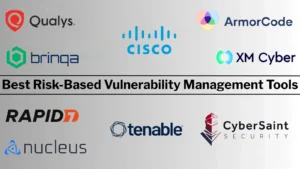
| S.NO | Vendor | Award | Score* |
| 1 | Tenable (VPR + Vulcan lineage) | Best scoring-plus-orchestration estate | 8.9 |
| 2 | Qualys (TruRisk) | Best platform-native risk scoring | 8.7 |
| 3 | Cisco (Kenna) | Best exploit-prediction pioneer | 8.5 |
| 4 | Nucleus Security | Best aggregation-and-routing layer | 8.3 |
| 5 | Brinqa | Best risk-graph orchestration | 8.2 |
| 6 | ArmorCode | Best ASPM-crossover aggregation | 8.1 |
| 7 | Rapid7 | Best program-embedded active risk | 7.9 |
| 8 | XM Cyber | Best attack-path-driven exposure prioritization | 7.8 |
| 9 | CyberSaint | Best risk-program crossover lane | 7.5 |
*Editorial research-based scores, not lab results.
1. Tenable (VPR + Vulcan Lineage) — Best Scoring-Plus-Orchestration Estate

Snapshot: Tenable One tiers | VPR threat-weighted scoring | Vulcan Cyber orchestration absorbed
Why it earns 1: Counted once, Tenable now holds both halves: VPR’s threat-intelligence-weighted scoring that collapses critical queues to the exploitable few, and the acquired Vulcan Cyber lineage adding cross-source aggregation and remediation orchestration above the scanners.
Scoring plus routing in one estate confirm the integrated packaging.
Pros: VPR maturity; orchestration lineage; exposure-platform unity.
Cons: Integration packaging post-acquisition worth verifying.
Bottom line: The consolidated scoring-and-routing estate.
2. Qualys (TruRisk) — Best Platform-Native Risk Scoring

Snapshot: Platform-included scoring | TruRisk across the Qualys stack | Patch-pipeline adjacency
Why it ranks here: TruRisk re-ranks the Qualys estate natively: exploit evidence, asset criticality, and compensating-control context scored where detection already happens, with the patch pipeline one module away. RBVM as a platform property rather than a bolt-on purchase.
Pros: Native integration; decomposable scoring; patch adjacency.
Cons: Scope strongest inside the Qualys estate.
Bottom line: Risk scoring where the findings already live.
3. Cisco (Kenna) — Best Exploit-Prediction Pioneer

Snapshot: Cisco Vulnerability Management packaging | Kenna’s predictive modeling lineage | Cross-scanner ingestion
Why it ranks here: Kenna invented the discipline’s math exploitation-probability modeling trained on real-world attack data, ingesting findings from any scanner and re-ranking them against evidence.
Under Cisco (as Cisco Vulnerability Management), the pioneering models continue; roadmap vigor under the new roof is the fair question.
Pros: Predictive-model pedigree; scanner-agnostic ingestion; decomposable scores.
Cons: Cisco-era momentum watch.
Bottom line: The original exploit-prediction engine.
4. Nucleus Security — Best Aggregation-and-Routing Layer

Snapshot: Platform subscription | Unifies scanner/cloud/appsec findings | Automated ownership routing
Why it ranks here: Nucleus runs the layer where multi-tool programs actually live: every finding source normalized and deduplicated, risk-ranked with your asset context, and routed automatically to owning teams with SLA tracking. The queue above the scanners, operationalized.
Pros: Aggregation depth; routing automation; SLA discipline.
Cons: A layer, not a scanner sources come from elsewhere.
Bottom line: One owned queue above all the finders.
5. Brinqa — Best Risk-Graph Orchestration

Snapshot: Enterprise platform | Risk graph connecting findings/assets/owners | Enterprise-scale orchestration
Why it ranks here: Brinqa models the enterprise as a risk graph: findings, assets, business services, and owners connected so prioritization inherits business context and remediation campaigns run at enterprise scale. The heavyweight orchestration pick for complex estates.
Pros: Graph-model depth; enterprise orchestration; business-context inheritance.
Cons: Implementation weight suits large programs.
Bottom line: The enterprise risk graph, operationalized.
6. ArmorCode — Best ASPM-Crossover Aggregation

Snapshot: Platform subscription | AppSec + infra findings unified | AI-assisted correlation
Why it ranks here: ArmorCode crosses the lanes most programs still silo: application-security findings (SAST, DAST, SCA) and infrastructure vulnerabilities unified, correlated, and risk-ranked in one plane with AI-assisted dedup. For estates where appsec and VM report to one owner, the crossover is the point.
Pros: AppSec+infra unification; AI correlation; routing workflow.
Cons: Younger ecosystem than the aggregation incumbents.
Bottom line: One risk plane across appsec and infra.
7. Rapid7 — Best Program-Embedded Active Risk

Snapshot: Platform-included scoring | Active Risk in InsightVM | Remediation projects
Why it ranks here: Rapid7’s Active Risk scoring embeds RBVM in the program mid-market teams already run: exploit-intelligence weighting informed by the Metasploit lineage, remediation projects carrying the re-ranked queue to owners.
Pragmatic RBVM without a second platform.
Pros: Program embedding; Metasploit-informed realism; owner workflow.
Cons: Cross-source aggregation breadth versus the layers.
Bottom line: RBVM inside the program you already run.
8. XM Cyber — Best Attack-Path-Driven Exposure Prioritization

Snapshot: Exposure-management platform | Attack-path analysis + exploitability context | Choke-point remediation prioritization
Why it ranks here: XM Cyber prioritizes exposures by showing how vulnerabilities, misconfigurations, identities, and controls combine into viable attack paths leading to critical assets.
Instead of treating every finding equally, it identifies the choke points where remediation can break multiple attack paths at once, giving security teams a more operational way to reduce real-world exposure.
Pros: Attack-path visibility; exploitability context; business-critical asset prioritization; choke-point remediation; continuous exposure analysis.
Cons: Less focused on dollar-denominated risk quantification than Balbix; strongest value comes from broader exposure-management programs.
Bottom line: The queue ranked by which fixes break the most dangerous paths to critical assets.
9. CyberSaint — Best Risk-Program Crossover Lane

Snapshot: Platform subscription | Control-posture risk scoring | FAIR-based translation
Why it ranks here — scoped honestly: CyberSaint enters from the risk-program side: control posture and framework data scored continuously with FAIR-based dollar translation vulnerability signals as one input to program-level risk rather than a finding-queue engine. The governance crossover, ranked as one.
Pros: Program-risk integration; dollar translation; framework automation.
Cons: Not a finding-queue RBVM engine.
Bottom line: The program-risk lane, honestly scoped.
Full Comparison Table
| Vendor | Class | Scoring transparency | Aggregation breadth | Remediation orchestration | Pricing model |
| Tenable | Scoring+orchestration | VPR (decomposable) | Vulcan lineage | Yes | Tenable One |
| Qualys | Platform-native | TruRisk | Platform-scoped | Patch-adjacent | Included/module |
| Cisco (Kenna) | Prediction pioneer | Model-decomposable | Scanner-agnostic | Partial | Packaging |
| Nucleus | Aggregation layer | Context-ranked | Core | Routing (core) | Subscription |
| Brinqa | Risk graph | Graph-contextual | Core | Campaigns (core) | Enterprise |
| ArmorCode | ASPM crossover | AI-correlated | AppSec+infra | Yes | Subscription |
| Rapid7 | Program-embedded | Active Risk | Platform-scoped | Projects | Included |
| XM Cyber | Attack-path exposure | Path/context-ranked | Broad exposure graph | Choke-point prioritized | Subscription |
| CyberSaint | Program crossover | FAIR-based | Program-level | Partial | Subscription |
Yes/No Capability Table
| Vendor | Exploitation-evidence scoring? | Ingests third-party scanner findings? | Your asset-criticality weighting? | Automated owner routing/SLAs? | Dollar-denominated outputs? |
| Tenable | Yes (VPR) | Yes (Vulcan lineage) | Yes | Yes | Partial |
| Qualys | Yes (TruRisk) | Partial | Yes | Yes (patch) | Partial |
| Cisco (Kenna) | Yes (core) | Yes (core) | Yes | Partial | Partial |
| Nucleus | Yes (via intel) | Yes (core) | Yes | Yes (core) | No |
| Brinqa | Yes | Yes (core) | Yes (graph) | Yes (core) | Partial |
| ArmorCode | Yes | Yes (appsec+infra) | Yes | Yes | No |
| Rapid7 | Yes | Partial | Yes | Yes | No |
| XM Cyber | Yes (attack-path/exploitabilit) | Yes | Yes (core) | Partial | No |
| CyberSaint | Partial | Partial | Yes | Partial | Yes (FAIR) |
Buying Advice: Shadow-Run the Score, Then Wire the Routing
RBVM succeeds as persuasion before plumbing: run the new prioritization in shadow mode against the severity-driven queue for a month and show patch owners the delta the dramatic shrink in “urgent” buys the goodwill every later SLA needs.
Demand decomposable scoring (exploit evidence, reachability, criticality factors a remediation standup can interrogate “proprietary risk score” is where RBVM programs die), validate exploit intelligence against incidents your sector actually saw, and invest early in the half vendors can’t ship: your asset-criticality tags, which take stakeholder weeks and change everything.
Choose architecture by source count platform-native scoring (TruRisk/VPR/Active Risk) for single-stack estates, aggregation layers (Nucleus/Brinqa/ArmorCode-class) at three-plus finders confirm the two acquisition packagings (Tenable–Vulcan, Kenna-under-Cisco), and publish the RBVM proof quarterly: exploitable-critical queue size and its half-life, both trending down.
FAQs
What are the best risk-based vulnerability management tools in 2026? Tenable (VPR plus the Vulcan lineage) leads, with Qualys TruRisk, Cisco’s Kenna pioneer, the aggregation layers (Nucleus, Brinqa, ArmorCode), Rapid7’s embedded Active Risk, Balbix’s dollar math, and CyberSaint’s program crossover.
Why nine vendors instead of ten? The sheet listed Tenable twice VPR and the acquired Vulcan Cyber consolidated and counted once.
How much does RBVM shrink the queue? Exploitation-evidence filtering routinely collapses critical queues by an order of magnitude the shadow-mode pilot proves your number.
Platform-native scoring or an aggregation layer? Single-scanner estates use native scoring; three-plus finding sources need the aggregation class for dedup, normalization, and unified routing.
What makes RBVM scores trustworthy? Decomposability: exploit evidence, reachability, and criticality factors owners can interrogate plus backtesting against incidents your sector actually experienced.
Verdict
Nine vendors, one consolidation, one conversion that matters: severity theater into exploitable truth. Tenable holds scoring and routing, Qualys and Rapid7 score natively, Kenna’s models pioneered the math, Nucleus and Brinqa and ArmorCode run the unified queues, Balbix prices it, CyberSaint folds it into program risk shadow-run the score, decompose the factors, tag the crown jewels, and let the shrinking exploitable queue make the argument.
Author: [AUTHOR NAME], [credential]. Reviewed by: [REVIEWER NAME]. Last updated: November 2026. Cybersecurity News editorial: independent, research-based rankings; no paid placement; scores are editorial and excluded from structured data.
Read next on Cybersecurity News:
• Top 10 Best Vulnerability Management Tools
• Top 10 Best Vulnerability Scanners
• Top 10 Best CTEM Platforms
• Top 10 Best Cloud Vulnerability Management Tools
• Top 10 Best Attack Surface Management Tools
• Top 10 Best Cyber Risk Quantification Tools
• Top 10 Best CAASM Tools
• Top 10 Best Threat Intelligence Platforms
• Top 10 Best Web Application Vulnerability Scanners
The post Top 10 Best Risk-Based Vulnerability Management Tools in 2026 [Ranked & Scored] appeared first on Cyber Security News.
Kaynak: Cyber Security News
Yayin Tarihi: 16.11.2026 07:03