Top 10 Best Cloud Vulnerability Management Tools in 2026 [Ranked & Scored]
8 min read
Cloud vulnerability management rewrote the category’s physics: agentless snapshot scanning covers an estate in hours, and the question stopped being “what’s vulnerable” everything is and became “what’s reachable, exploitable, and attached to something that matters.”
The 2026 leaders answer with context graphs: vulnerability joined to exposure, identity, and data sensitivity. Wiz takes 1; Palo Alto Prisma Cloud and Orca complete the podium.
Key Takeaways
• 1 overall: Wiz the toxic-combination graph that redefined cloud prioritization.
• Podium: Wiz, Prisma Cloud (platform breadth), Orca (agentless pioneering depth).
• Acquisition note: Lacework now ships under Fortinet packaging and roadmap confirmation belongs in procurement.
• 2026 theme: runtime context agentless breadth plus runtime sensors (Sysdig-class, and the leaders’ sensor add-ons) separating theoretical findings from loaded-in-memory truth.
How We Scored (Methodology)
Research-based evaluation; no lab testing, no paid placement; editorial scores excluded from structured data.
Criteria: context-graph quality (reachability, identity, data), agentless coverage speed, runtime-validation fusion, multi-cloud parity, remediation workflow (code-to-cloud), and pricing clarity.
Weights: context quality 25%, coverage speed 20%, runtime fusion 20%, multi-cloud parity 15%, remediation workflow 20%.
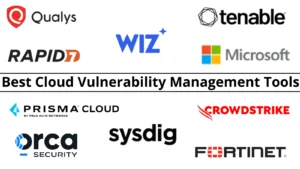
The 2026 Cloud VM Power Rankings
| S.No | Tool | Award | Score* |
| 1 | Wiz | Best context-graph prioritization | 9.1 |
| 2 | Palo Alto (Prisma Cloud) | Best platform-breadth CNAPP | 8.7 |
| 3 | Orca Security | Best agentless depth pioneer | 8.6 |
| 4 | Microsoft Defender for Cloud | Best estate-bundled cloud VM | 8.4 |
| 5 | CrowdStrike | Best runtime-fused cloud security | 8.3 |
| 6 | Sysdig | Best runtime-truth prioritization | 8.2 |
| 7 | Tenable Cloud Security | Best VM-estate cloud extension | 8.0 |
| 8 | Qualys (TotalCloud) | Best platform-consolidated cloud VM | 7.9 |
| 9 | Rapid7 (InsightCloudSec) | Best mid-market cloud program | 7.7 |
| 10 | Fortinet (Lacework) | Best behavior-anomaly cloud lane | 7.6 |
Editorial research-based scores, not lab results.
1. Wiz — Best Context-Graph Prioritization

Snapshot: Workload/cloud-size tiers | Agentless graph across exposure/identity/data | Code-to-cloud expansion
Why it earns 1: Wiz made “critical” mean something again: agentless scanning graphs every vulnerability against network exposure, identity blast radius, and data sensitivity, surfacing the toxic combinations internet-reachable, privilege-attached, data-adjacent that deserve tonight’s attention.
Deployment in hours, prioritization the cloud teams actually accept, and code-to-cloud tracing closing the loop to the repo.
Pros: Toxic-combination graph; deployment speed; cross-cloud parity; developer adoption.
Cons: Premium economics; runtime sensors are the add-on conversation.
Bottom line: The graph that ended CVSS triage in the cloud.
2. Palo Alto (Prisma Cloud) — Best Platform-Breadth CNAPP

Snapshot: Credit-based licensing| Full CNAPP span | Cortex-era convergence
Why it ranks here: Prisma Cloud covers the CNAPP waterfront posture, workload, identity, code, and vulnerability context at a breadth few match, with Cortex-side convergence tying cloud findings into enterprise response.
Credit licensing demands governance; the span is the argument.
Pros: CNAPP breadth; code-security integration; enterprise response ties.
Cons: Credit-model governance; module complexity.
Bottom line: The waterfront CNAPP, credits managed.
3. Orca Security — Best Agentless Depth Pioneer

Snapshot: Workload tiers | SideScanning lineage | Unified data model
Why it ranks here: Orca securityinvented the agentless pattern (SideScanning) and keeps it deep: full-estate visibility in hours, vulnerabilities contextualized against exposure and data in a unified model, attack-path views without an agent anywhere.
The pioneer still setting agentless pace.
Pros: Agentless pioneering depth; unified context; fast time-to-visibility.
Cons: Runtime-sensor lane pairs from elsewhere.
Bottom line: The agentless original, still sharp.
4. Microsoft Defender for Cloud — Best Estate-Bundled Cloud VM

Snapshot: Per-resource Defender plans | Azure-native + AWS/GCP connectors | Secure Score integration
Why it ranks here: Microsoft Defender for Cloud rides the Azure estate: agentless scanning and posture across subscriptions, multi-cloud connectors reaching AWS and GCP, prioritization fed by Microsoft threat telemetry, and remediation flowing through the governance plane teams already run. Azure-majority estates start here by gravity.
Pros: Estate-native economics; multicloud connectors; telemetry-weighted ranking.
Cons: Cross-cloud depth parity versus the pure-plays.
Bottom line: The Azure estate’s default, reaching outward.
5. CrowdStrike — Best Runtime-Fused Cloud Security

Snapshot: Falcon Cloud Security modules | Agent+agentless fusion | Adversary-intel prioritization
Why it ranks here: CrowdStrike fuses the lanes: agentless estate scanning plus Falcon runtime sensors where it matters, prioritization tuned by adversary telemetry, and cloud findings living in the same console as endpoint detection.
For Falcon estates, cloud VM arrives with runtime truth included.
Pros: Agent+agentless fusion; adversary-informed ranking; console unification.
Cons: Falcon-estate coupling.
Bottom line: Cloud exposure with runtime receipts.
6. Sysdig — Best Runtime-Truth Prioritization

Snapshot: Workload tiers | Runtime-insights lineage (Falco heritage) | In-use vulnerability filtering
Why it ranks here: Sysdig’s runtime lineage answers the noise problem differently: which vulnerable packages are actually loaded and executing in-use exposure filtering that routinely collapses finding queues by large multiples, built on the Falco open-source heritage.
Runtime truth as the prioritization engine.
Pros: In-use filtering; Falco pedigree; container-runtime depth.
Cons: Agentless-breadth lane pairs with the graph leaders.
Bottom line: Only what’s actually running, ranked.
7. Tenable Cloud Security — Best VM-Estate Cloud Extension

Snapshot: Tenable One integration | Ermetic lineage (CIEM-strong) | Exposure-platform math
Why it ranks here: Tenable’s cloud security lane (Ermetic lineage) brings identity-first depth CIEM-grade entitlement analysis joined to workload scanning with findings landing in the same exposure platform as the rest of the estate. For Tenable programs, cloud joins the one queue.
Pros: CIEM-strong context; exposure-platform unity; identity depth.
Cons: Pure-play graph breadth race.
Bottom line: Identity-first cloud VM in the Tenable estate.
8. Qualys (TotalCloud) — Best Platform-Consolidated Cloud VM

Snapshot: Per-resource/module tiers | TotalCloud with TruRisk | One-platform consolidation
Why it ranks here: TotalCloud extends the Qualys consolidation thesis to cloud: agentless and agent coverage, TruRisk prioritization, and findings sharing the platform with VM, patch, and compliance. For Qualys estates, cloud VM is a module toggle, not a migration.
Pros: Platform consolidation; TruRisk continuity; flexible coverage.
Cons: Cloud-native ergonomics race the pure-plays.
Bottom line: Cloud VM inside the consolidation play.
9. Rapid7 (InsightCloudSec) — Best Mid-Market Cloud Program

Snapshot: Per-resource pricing | CSPM+VM with automation | Program pairing
Why it ranks here: InsightCloudSec delivers cloud posture and vulnerability context with automation-first ergonomics (auto-remediation bots for the misconfigurations that recur) at mid-market economics, pairing with the Rapid7 program machinery.
Pragmatism over frontier breadth.
Pros: Automation bots; accessible economics; program pairing.
Cons: Context-graph depth versus leaders.
Bottom line: The pragmatic mid-market cloud lane.
10. Fortinet (Lacework) — Best Behavior-Anomaly Cloud Lane

Snapshot: Fortinet integration packaging | Polygraph behavior analytics | FortiCNAPP convergence
Why it ranks here — acquisition noted: Lacework’s distinctive asset Polygraph behavioral analytics baselining cloud activity and flagging anomalies alongside vulnerabilities now ships under Fortinet as the FortiCNAPP lineage.
The behavior lens stays differentiated; packaging and roadmap under the new roof belong in procurement questions.
Pros: Behavioral-anomaly depth; Fabric integration path.
Cons: Acquisition-era packaging confirmation.
Bottom line: The behavior lens, under a new roof.
Full Comparison Table
| Tool | Class | Context graph | Runtime fusion | Multi-cloud parity | Pricing model |
| Wiz | Context leader | Toxic combinations (core) | Sensor add-on | Strong | Cloud tiers |
| Prisma Cloud | CNAPP waterfront | Yes | Yes | Strong | Credits |
| Orca | Agentless pioneer | Yes (unified) | Partial | Strong | Workload tiers |
| Defender for Cloud | Estate-bundled | Yes | Yes (Defender) | Connector-based | Per-resource plans |
| CrowdStrike | Runtime-fused | Yes | Core (Falcon) | Strong | Modules |
| Sysdig | Runtime truth | Partial | In-use (core) | Strong | Workload tiers |
| Tenable Cloud | Estate extension | Identity-first | Partial | Strong | Tenable One |
| TotalCloud | Platform-consolidated | Yes | Partial | Strong | Per-resource |
| InsightCloudSec | Mid-market program | Partial | Partial | Strong | Per-resource |
| Fortinet/Lacework | Behavior lane | Polygraph | Yes | Strong | Fortinet packaging |
Yes/No Capability Table
| Tool | Agentless full-estate scanning? | Reachability/toxic-combination analysis? | In-use/runtime vulnerability filtering? | Code-to-cloud tracing? | CIEM/identity context included? |
| Wiz | Yes (core) | Yes (core) | Partial (sensor) | Yes | Yes |
| Prisma Cloud | Yes | Yes | Yes | Yes | Yes |
| Orca | Yes (core) | Yes | Partial | Yes | Yes |
| Defender for Cloud | Yes | Yes | Yes | Partial | Yes |
| CrowdStrike | Yes | Yes | Yes (Falcon) | Partial | Yes |
| Sysdig | Yes | Partial | Yes (core) | Yes | Partial |
| Tenable Cloud | Yes | Yes | Partial | Partial | Yes (core) |
| TotalCloud | Yes | Yes | Partial | Partial | Partial |
| InsightCloudSec | Yes | Partial | Partial | Partial | Yes |
| Fortinet/Lacework | Yes | Yes (behavior) | Yes | Partial | Partial |
Buying Advice: Demand Reachability Proof, Then Add Runtime Truth
The pilot question that separates the field: show me the ten findings you’d fix first, and why a context leader answers with reachability, identity blast radius, and data adjacency; a scanner answers with CVSS 9.8s nobody can exploit.
Run finalists against the same cloud accounts and compare queue sizes after context filtering (the collapse factor is the product), then layer runtime truth where it pays: in-use filtering (Sysdig-class, or the leaders’ sensors) for container-dense estates where loaded-versus-installed is the real question.
Weigh estate gravity honestly Defender for Cloud and the platform extensions cover real ground at marginal cost inside their compliance management frameworks govern credit/consumption models before the bill teaches you, and confirm the Lacework-under-Fortinet packaging where that lens is shortlisted.
Wire remediation code-to-cloud: findings routed to the owning repo and team, not a cloud-security inbox, because in the cloud the fix is a pull request.
FAQs
What are the best cloud vulnerability management tools in 2026?
Wiz for context-graph prioritization, Prisma Cloud for CNAPP breadth, Orca for agentless depth, with Defender for Cloud, CrowdStrike, Sysdig, Tenable Cloud Security, Qualys TotalCloud, InsightCloudSec, and Fortinet (Lacework) by estate and lens.
What are toxic combinations?
Findings that intersect internet-reachable plus exploitable plus privilege-attached plus data-adjacent the graph-ranked intersections that deserve immediate attention over raw severity scores.
Agentless or agent-based cloud scanning?
Agentless for breadth and speed (full estate in hours), runtime sensors for in-use truth and live defense the mature architecture layers both (cloud-native security platforms).
How is cloud VM different from traditional VM?
Context replaces severity: cloud estates make everything findable, so reachability, identity, and data adjacency decide priority and remediation routes to repos, not patch windows.
What happened to Lacework?
Acquired by Fortinet its Polygraph behavioral analytics continue under the FortiCNAPP lineage; confirm packaging and roadmap in procurement.
Verdict
Ten tools, one question that sorts them: why these ten findings first? Wiz answers with the graph, Prisma with the waterfront, Orca with agentless depth, Microsoft and the platform extensions with estate gravity, CrowdStrike and Sysdig with runtime receipts, Lacework’s behavior lens under Fortinet’s roof demand reachability proof, layer in-use truth, route fixes to repos, and let the queue-collapse factor pick your winner.
Author: [AUTHOR NAME], [credential]. Reviewed by: [REVIEWER NAME]. Last updated: November 2026. Cybersecurity News editorial: independent, research-based rankings; no paid placement; scores are editorial and excluded from structured data.
Read next on Cybersecurity News:
• Top 10 Best Vulnerability Management Tools
• Top 10 Best Cloud Security Tools
• Top 10 Best Attack Surface Management Tools
• Top 10 Best Risk-Based Vulnerability Management Tools
• Top 10 Best CTEM Platforms
• Top 10 Best Vulnerability Scanners
• Top 10 Best CAASM Tools
• Top 10 Best Web Application Vulnerability Scanners
The post Top 10 Best Cloud Vulnerability Management Tools in 2026 [Ranked & Scored] appeared first on Cyber Security News.
Kaynak: Cyber Security News
Yayin Tarihi: 16.11.2026 06:55