
Top 10 Best Continuous Threat Exposure Management (CTEM) Platforms in 2026 [Ranked & Scored]
8 min read
CTEM is a five-stage operating rhythm scope, discover, prioritize, validate, mobilize and no single product runs it all, whatever the datasheets imply.
The honest buying question is which stages each platform genuinely covers, with validation (the stage most organizations skip) as the differentiator that separates exposure management from vulnerability management wearing new branding. XM Cyber takes 1; Cymulate and Tenable complete the podium.
Key Takeaways
• 1 overall: XM Cyber attack-path validation as the program’s spine.
• Podium: XM Cyber (path validation), Cymulate (validation-to-exposure convergence), Tenable (discovery-and-prioritization breadth).
• Stage honesty: every entry below is mapped to the CTEM stages it actually covers most estates compose two platforms, not one.
• Status note: Skybox Security’s corporate situation requires verification before contracting capability discussed behind that gate.
How We Scored (Methodology)
Research-based evaluation; no lab testing, no paid placement; editorial scores excluded from structured data.
Criteria: stage coverage honesty, validation realism (paths proven, controls tested), discovery breadth (internal+external), prioritization quality (choke points, reachability), mobilization workflow, and pricing clarity.
Weights: validation 25%, stage coverage 20%, discovery 20%, prioritization 20%, mobilization 15%.
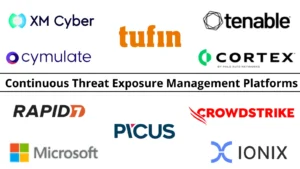
The 2026 CTEM Power Rankings
| S.No | Platform | Award | Score* |
| 1 | XM Cyber | Best attack-path validation spine | 8.8 |
| 2 | Cymulate | Best validation-to-exposure convergence | 8.7 |
| 3 | Tenable | Best discovery-and-prioritization estate | 8.5 |
| 4 | Palo Alto (Cortex Xpanse) | Best external discovery engine | 8.3 |
| 5 | Microsoft | Best estate-bundled exposure management | 8.2 |
| 6 | CrowdStrike | Best adversary-informed exposure | 8.1 |
| 7 | Picus Security | Best control-validation-led CTEM | 8.0 |
| 8 | Rapid7 | Best mid-market exposure command | 7.8 |
| 9 | IONIX | Best exploitable-surface discovery | 7.7 |
| 10 | Skybox Security | Best model-based exposure analysis — status gated | 7.2 |
Editorial research-based scores, not lab results.
1. XM Cyber — Best Attack-Path Validation Spine

Snapshot: SaaS platform | Continuous path computation to crown jewels | Choke-point remediation math
Why it earns 1: XM Cyber runs CTEM’s hardest stage continuously: computing how attackers chain misconfigurations, credentials, and exposures from breach points to crown jewels, then ranking the choke-point fixes that sever the most paths.
Validation as standing capability rather than annual event the stage most programs fake, automated. (Stages: discover, prioritize, validate core.)
Pros: Continuous path validation; choke-point economics; hybrid/cloud graphing.
Cons: External discovery and mobilization pair from elsewhere.
Bottom line: The validation spine a CTEM program builds around.
2. Cymulate — Best Validation-to-Exposure Convergence

Snapshot: Module-based SaaS | BAS lineage converged into exposure management | Full-surface validation
Why it ranks here: Cymulate converged its BAS depth into a CTEM frame: control validation across email, web, endpoint, and lateral-movement surfaces feeding an exposure-management layer that scores and mobilizes.
The validation-first route into the full cycle, operable by lean teams. (Stages: prioritize, validate core; mobilize strong.)
Pros: Validation breadth; exposure convergence; lean-team ergonomics.
Cons: Discovery depth pairs with surface engines.
Bottom line: Validation-led CTEM, assembled.
3 .Tenable — Best Discovery-and-Prioritization Estate

Snapshot: Tenable One tiers | VM+cloud+identity+external in one exposure math | VPR prioritization
Why it ranks here: Tenable One rolls the widest discovery estate into one prioritization plane: infrastructure, cloud, identity, web, and external surface scored together, with VPR threat-weighting and attack-path features maturing.
The scope-discover-prioritize anchor most programs start from. (Stages: scope, discover, prioritize core.)
Pros: Discovery breadth; unified exposure math; estate integration.
Cons: Validation realism pairs with the spine players.
Bottom line: The discovery-and-ranking anchor.
4. Palo Alto (Cortex Xpanse) — Best External Discovery Engine

Snapshot: Cortex module structure | Attacker’s-eye internet discovery | XSIAM mobilization path
Why it ranks here: Cortex Xpanse discovers what attackers scan first: your actual internet-facing estate, including the assets nobody registered, continuously mapped from the outside with ownership attribution.
Inside the Cortex stack, findings flow toward XSIAM’s automation for the mobilize stage. (Stages: scope, discover core; mobilize via Cortex.)
Pros: External-discovery authority; attribution quality; automation path.
Cons: Internal-path validation pairs from elsewhere.
Bottom line: The outside-in discovery engine.
5. Microsoft — Best Estate-Bundled Exposure Management

Snapshot: Defender/E5-adjacent licensing | Security Exposure Management across the estate | Attack-path features
Why it ranks here: Microsoft’s Security Exposure Management unifies the estate it already watches: Defender signals, Secure Score posture, attack-path analysis across identity and endpoint, and critical-asset tagging exposure management arriving as a capability of licenses many estates hold. (Stages: scope, discover, prioritize strong; validate maturing.)
Pros: Bundled economics; estate-signal depth; attack-path maturing.
Cons: Cross-vendor estate coverage; validation depth.
Bottom line: CTEM’s first three stages, possibly already licensed.
6. CrowdStrike — Best Adversary-Informed Exposure

Snapshot: Falcon Exposure Management modules | Adversary-telemetry prioritization | Agent+surface fusion
Why it ranks here: CrowdStrike scores exposure by who’s actually attacking: Falcon Exposure Management fusing agent-truth asset data with external surface and ranking by live adversary behavior from its intel estate.
For Falcon shops, exposure joins the console the SOC already works. (Stages: discover, prioritize core.)
Pros: Adversary-informed ranking; console unification; agent-truth assets.
Cons: Validation stage pairs with the spine players.
Bottom line: Exposure ranked by real adversary interest.
7. Picus Security — Best Control-Validation-Led CTEM

Snapshot: Platform subscription | Validation with per-vendor fixes | Exposure-scoring convergence
Why it ranks here: Picus security leads with the fix: control validation whose failures ship vendor-specific signatures and rules, now converged into exposure scoring that feeds the mobilize stage with actionable work rather than findings.
Validation that tunes as it tests. (Stages: validate core; prioritize, mobilize strong.)
Pros: Fix-shipping validation; tuning-loop design; accessible operation.
Cons: Discovery breadth pairs upstream.
Bottom line: The validator that hands mobilization its work items.
8. Rapid7 — Best Mid-Market Exposure Command

Snapshot: Exposure Command packaging | Surface+VM+cloud unified | Program pragmatism
Why it ranks here: Rapid7’s Exposure Command rolls surface discovery, VM, and cloud context into a mid-market-operable plane with the remediation-project machinery its programs are known for.
The attainable full-cycle attempt for teams without platform engineers. (Stages: discover, prioritize, mobilize balanced.)
Pros: Balanced coverage; program workflow; accessible economics.
Cons: Stage-depth peaks sit with specialists.
Bottom line: The pragmatic full-cycle middle.
9. IONIX — Best Exploitable-Surface Discovery

Snapshot: Subscription tiers | Exploitability-validated external surface | Digital supply-chain reach
Why it ranks here: IONIX discovers the external estate and validates what’s actually exploitable active testing separating theoretical exposure from reachable risk, with digital-supply-chain connections (the services your services depend on) mapped in.
Discovery with a validation conscience. (Stages: discover core; validate external.)
Pros: Exploitability validation; supply-chain mapping; noise economy.
Cons: Internal-estate stages pair from elsewhere.
Bottom line: External discovery that proves its findings.
10. Skybox Security — Best Model-Based Exposure Analysis, Status Gated

Snapshot: Module licensing | Network-model path analysis | Corporate-status verification first
Why it ranks here: Skybox’s security analytical lineage network modeling that computes exposure and attack paths across firewall and routing reality remains technically distinctive, but 2024-era restructuring reports make corporate-status verification the first procurement step.
Capability ranked; diligence gated. (Stages: discover, prioritize model-based.)
Pros: Network-model depth; policy-context analysis.
Cons: Status homework precedes evaluation.
Bottom line: Verify the company before the product.
Full Comparison Table
| Platform | CTEM stages (core) | Validation realism | Discovery breadth | Mobilization | Pricing model |
| XM Cyber | Discover/prioritize/validate | Path-proven (core) | Internal+cloud | Choke-point fixes | SaaS |
| Cymulate | Prioritize/validate/mobilize | Control-tested (core) | Via modules | Yes | Modules |
| Tenable | Scope/discover/prioritize | Maturing | Widest estate | Workflow | Tenable One |
| Xpanse | Scope/discover (external) | Partial | External (core) | Via Cortex | Modules |
| Microsoft | Scope/discover/prioritize | Maturing | Estate-deep | Via Defender | Bundled-adjacent |
| CrowdStrike | Discover/prioritize | Partial | Agent+surface | Via Falcon | Modules |
| Picus | Validate/mobilize | Fix-shipping (core) | Via sources | Work items | Subscription |
| Rapid7 | Discover/prioritize/mobilize | Partial | Balanced | Projects | Packaging |
| IONIX | Discover (external) | Exploit-validated | External+supply chain | Partial | Tiers |
| Skybox | Discover/prioritize | Model-based | Network-model | Partial | Status-gated |
Yes/No Capability Table
| Platform | Attack-path computation to crown jewels? | Safe control/exploit validation? | External (attacker’s-eye) discovery? | Choke-point/fix ranking? | Operable by lean teams? |
| XM Cyber | Yes (core) | Yes (paths) | Partial | Yes (core) | Partial |
| Cymulate | Partial | Yes (core) | Partial | Yes | Yes |
| Tenable | Yes (maturing) | Partial | Yes | Yes | Partial |
| Xpanse | No | Partial | Yes (core) | Partial | Partial |
| Microsoft | Yes | Partial | Yes (EASM) | Yes | Yes (bundled) |
| CrowdStrike | Partial | Partial | Yes | Yes | Yes |
| Picus | Partial | Yes (core) | No | Yes (fixes) | Yes |
| Rapid7 | Partial | Partial | Yes | Yes | Yes |
| IONIX | No | Yes (external) | Yes (core) | Partial | Yes |
| Skybox | Yes (model) | No | Partial | Yes | Partial |
Buying Advice: Staff the Cycle, Compose the Stages, Skip Nothing
CTEM fails as a SKU and succeeds as a calendar: name owners for all five stages (several hats on one head is fine; unnamed stages are not), then compose honestly a discovery-and-prioritization anchor (Tenable/Microsoft/CrowdStrike-class by estate gravity) plus a validation spine (XM Cyber’s paths, Cymulate/Picus’s control tests), with external truth (Xpanse/IONIX-class) if your internet estate sprawls.
Refuse to skip validation: unvalidated exposure lists are vulnerability management rebranded, and the proof is one quarter’s choke-point fixes severing measured paths.
Start scoped one crown-jewel business service end-to-end publish the first exposure-reduction number inside ninety days, and let breadth follow credibility.
Inventory connectors against your real stack before any contract (CTEM consumes scanners, cloud posture, identity, and ticketing on both ends), run the Skybox status check before evaluation hours, and hold the program to its two numbers: validated paths severed per quarter, and median days from prioritized finding to mobilized fix.
FAQs
What are the best CTEM platforms in 2026?
XM Cyber for path validation, Cymulate for validation-to-exposure convergence, Tenable for discovery breadth, with Xpanse, Microsoft, CrowdStrike, Picus security, Rapid7, IONIX, and Skybox (status-gated) mapped by stage.
Is CTEM a product or a program?
A program a five-stage operating rhythm most estates run on two composed platforms plus owned process; no single SKU covers the cycle honestly.
What separates CTEM from vulnerability management?
Validation and mobilization: exposures proven exploitable along real paths, and fixes routed as owned work without those stages, it’s VM with new branding.
Which stage gets skipped most?
Validation budget for safe exploit simulation or path confirmation, because unvalidated lists regress to scanner output.
How do we measure a CTEM program?
Validated attack paths severed per quarter, and days from prioritized finding to mobilized fix exposure reduction you can prove, not counts.
Verdict
Ten platforms, five stages, one rule: compose, don’t believe the single-SKU story.
XM Cyber proves the paths, Cymulate and Picus test the controls, Tenable and Microsoft and CrowdStrike anchor discovery by estate, Xpanse and IONIX watch the outside, Rapid7 runs the pragmatic middle, Skybox waits behind a status check name the stage owners, validate or admit you’re doing VM, and publish the paths-severed number that makes the program real.
Author: [AUTHOR NAME], [credential]. Reviewed by: [REVIEWER NAME]. Last updated: November 2026. Cybersecurity News editorial: independent, research-based rankings; no paid placement; scores are editorial and excluded from structured data.
Read next on Cybersecurity News:
• Top 10 Best Attack Surface Management Tools
• Top 10 Best Vulnerability Management Tools
• Top 10 Best Risk-Based Vulnerability Management Tools
• Top 10 Best Cloud Vulnerability Management Tools
• Top 10 Best CAASM Tools
• Top 10 Best Vulnerability Scanners
• Top 10 Best Threat Intelligence Platforms
• Top 10 Best Cyber Risk Quantification Tools
• Top 10 Best Security Ratings Services
The post Top 10 Best Continuous Threat Exposure Management (CTEM) Platforms in 2026 [Ranked & Scored] appeared first on Cyber Security News.
Kaynak: Cyber Security News
Yayin Tarihi: 16.11.2026 07:08