Top 10 Best Attack Surface Management (ASM/EASM) Tools in 2026 [Ranked & Scored]
8 min read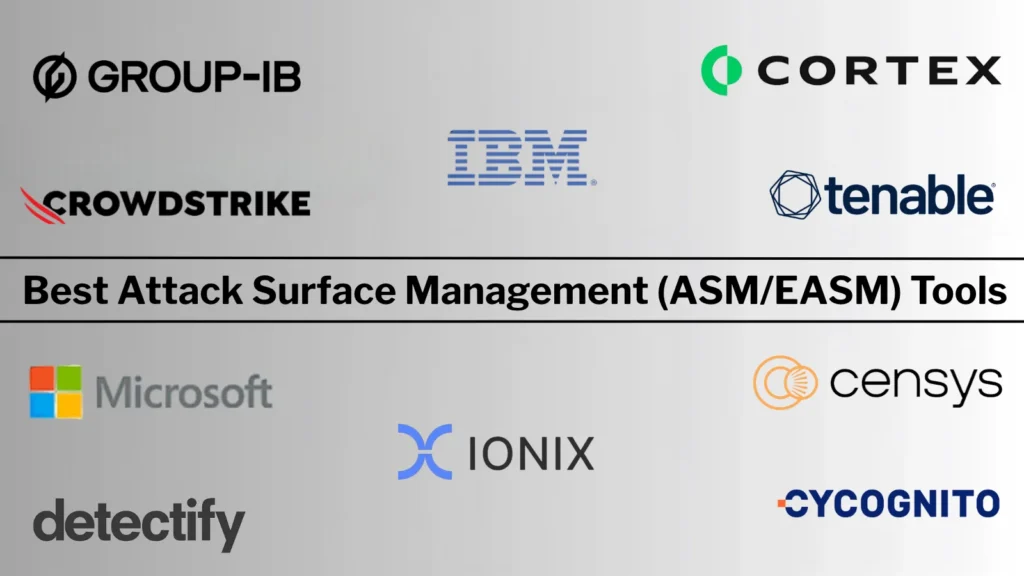
External attack surface management answers the question attackers answer daily and most defenders never have: what of yours is actually reachable from the internet right now? The 2026 field divides into continuous-discovery engines, suite-integrated surface modules, and internet-scan authorities with attribution accuracy (whose asset is this, really?) as the category’s chronic make-or-break.
Palo Alto Cortex Xpanse takes 1; Microsoft Defender EASM and CyCognito complete the podium.
Key Takeaways
• 1 overall: Cortex Xpanse attacker’s-eye discovery at internet scale with attribution depth.
• Podium: Xpanse, Defender EASM (estate-bundled surface truth), CyCognito (attacker-logic discovery with testing).
• Roster notes: IBM’s Randori lineage carries portfolio-era packaging questions; Detectify enters from the payload-testing side both scoped honestly.
• 2026 theme: freshness velocity the new cloud bucket appearing in your map in hours versus weeks is the operational difference between EASM and archaeology.
How We Scored (Methodology)
Research-based evaluation; no lab testing, no paid placement; editorial scores excluded from structured data.
Criteria: discovery depth and attribution accuracy, refresh velocity, exploitability validation, ownership-routing workflow, supply-chain/subsidiary reach, and pricing clarity.
Weights: attribution accuracy 25%, discovery depth 20%, freshness 20%, validation 20%, workflow 15%.
The 2026 ASM Power Rankings
| S.NO | Tool | Award | Score* |
| 1 | Palo Alto (Cortex Xpanse) | Best internet-scale attribution | 8.9 |
| 2 | Microsoft (Defender EASM) | Best estate-bundled surface mapping | 8.6 |
| 3 | CyCognito | Best attacker-logic discovery with testing | 8.5 |
| 4 | Censys | Best internet-scan data authority | 8.4 |
| 5 | CrowdStrike (Falcon Surface) | Best console-unified surface | 8.2 |
| 6 | Tenable | Best exposure-estate surface extension | 8.1 |
| 7 | IONIX | Best exploitability-validated surface | 8.0 |
| 8 | IBM (Randori) | Best adversarial-recon lineage — portfolio note | 7.8 |
| 9 | Group-IB | Best fraud-and-APAC surface lens | 7.6 |
| 10 | Detectify | Best payload-tested surface lane | 7.5 |
*Editorial research-based scores, not lab results.
1. Palo Alto ( Xpanse) — Best Internet-Scale Attribution

Snapshot: Cortex module structure | Continuous internet-wide discovery | Ownership attribution depth
Why it earns 1: Xpanse scans the way adversaries do the whole internet, continuously and attributes what it finds with the depth that makes findings actionable: this forgotten subdomain, that acquisition’s server, your cloud bucket spun up Tuesday.
Inside Cortex, discoveries route toward automation; standalone, the attribution engine is the draw.
Pros: Internet-scale discovery; attribution depth; freshness velocity; Cortex routing.
Cons: Platform economics; validation stage pairs elsewhere.
Bottom line: The attacker’s reconnaissance, running for you.
2. Microsoft (Defender EASM) — Best Estate-Bundled Surface Mapping

Snapshot: Defender EASM licensing | Seeded discovery with estate linkage | Exposure-management fusion
Why it ranks here: Defender EASM maps the external estate and joins it to the internal one Microsoft already watches: discoveries linked to Defender device and identity context, findings flowing into Security Exposure Management’s attack paths.
For Microsoft estates, outside-in truth arrives pre-integrated.
Pros: Estate fusion; bundled-adjacent economics; exposure-path integration.
Cons: Internet-scan authority depth versus the dedicated engines.
Bottom line: The external map wired to your internal one.
3. CyCognito — Best Attacker-Logic Discovery with Testing

Snapshot: Platform tiers | Graph-based reconnaissance | Active security testing on discoveries
Why it ranks here: CyCognito reconstructs attacker logic: graphing organizational relationships (subsidiaries, acquisitions, partners) to find the assets nobody claimed, then actively testing discoveries for exploitability so the queue arrives risk-ranked rather than raw.
Discovery plus proof in one pass.
Pros: Subsidiary-graph discovery; active testing; risk-ranked output.
Cons: Platform depth priced accordingly.
Bottom line: Finds the unclaimed, proves the exploitable.
4. Censys — Best Internet-Scan Data Authority

Snapshot: Platform + data tiers | The internet-wide scan dataset | Research-grade depth
Why it ranks here: Censys owns the substrate: internet-wide scan data of research-grade depth and freshness, with an ASM platform built atop and the raw dataset powering half the industry’s investigations. For teams that want the scan truth itself hunt, research, attribution the authority is the product.
Pros: Dataset authority; research depth; API access to raw truth.
Cons: Workflow layers thinner than suite rivals.
Bottom line: The internet’s scan record, queryable.
5. CrowdStrike (Falcon Surface) — Best Console-Unified Surface

Snapshot: Falcon module | EASM in the Falcon console | Adversary-intel prioritization
Why it ranks here: Falcon Surface puts the external map where the SOC already works: discoveries prioritized by CrowdStrike’s adversary intelligence, joined to the agent-truth internal estate, actioned from the same console as detections.
The unification argument for Falcon shops.
Pros: Console unity; adversary-informed ranking; internal-external join.
Cons: Dedicated-engine discovery depth race.
Bottom line: The surface map in the SOC’s console.
6. Tenable — Best Exposure-Estate Surface Extension

Snapshot: Tenable One integration | ASM within the exposure platform | Unified prioritization
Why it ranks here: Tenable’s ASM (Bit Discovery lineage) feeds the exposure estate: external discoveries landing in the same prioritization math as infrastructure, cloud, and identity findings.
For Tenable programs, the surface is one more input to the one queue.
Pros: Exposure-platform unity; one-queue economics.
Cons: Standalone-engine depth versus leaders.
Bottom line: The surface joins the exposure math.
7. IONIX — Best Exploitability-Validated Surface

Snapshot: Subscription tiers | Active exploitability validation | Digital supply-chain mapping
Why it ranks here: IONIX validates as it discovers: active testing separating reachable-and-exploitable from theoretically-present, plus digital supply-chain mapping of the third-party services your services depend on.
The noise-economy pick fewer findings, more of them true.
Pros: Exploit validation; supply-chain reach; signal economy.
Cons: Ecosystem gravity versus the anchors.
Bottom line: The surface map that proves its claims.
8. IBM (Randori) — Best Adversarial-Recon Lineage, Portfolio Note

Snapshot: IBM portfolio packaging | Attacker’s-perspective recon + continuous red teaming | Target-temptation ranking
Why it ranks here: Randori’s distinctive craft reconnaissance that ranks discoveries by attacker temptation, flowing into continuous automated red teaming continues inside IBM’s portfolio.
The recon-to-attack pipeline stays differentiated; portfolio-era packaging and roadmap deserve written confirmation.
Pros: Temptation-ranked recon; red-team pipeline; IBM integration.
Cons: Portfolio packaging clarity.
Bottom line: The adversary’s shopping list, with receipts to confirm.
9. Group-IB — Best Fraud-and-APAC Surface Lens

Snapshot: Intelligence tiers | Surface + fraud infrastructure + regional depth | Takedown services
Why it ranks here: Group-IB’s surface lens extends where Western majors thin out: fraud and scam infrastructure targeting your brand, APAC/EMEA regional depth, and takedown machinery to act on findings.
The regional-and-fraud-weighted shortlist entry, with jurisdiction posture checked per your markets.
Pros: Fraud-infrastructure depth; regional coverage; takedown execution.
Cons: Western-market gravity; jurisdiction check per buyer.
Bottom line: The surface lens with a fraud microscope.
10. Detectify — Best Payload-Tested Surface Lane

Snapshot: Per-domain/app tiers | Crowdsourced payloads on discovered surface | App-layer depth
Why it ranks here scoped honestly: Detectify enters from the testing side: surface discovery paired with ethical-hacker-sourced payloads actually run against what’s found app-layer validation more than estate-scale attribution. The payload-tested lane of the surface market, ranked as such.
Pros: Crowd-payload currency; app-layer validation; automation.
Cons: Estate-scale attribution depth sits with the engines.
Bottom line: The crowd’s payloads on your perimeter.
Full Comparison Table
| Tool | Class | Attribution accuracy | Exploit validation | Freshness velocity | Pricing model |
| Xpanse | Internet-scale engine | Core strength | Partial | Hours-class | Modules |
| Defender EASM | Estate-bundled | Strong | Partial | Strong | Bundled-adjacent |
| CyCognito | Attacker-logic | Graph-based (core) | Active testing | Strong | Tiers |
| Censys | Data authority | Strong | Partial | Scan-fresh | Platform+data |
| Falcon Surface | Console-unified | Strong | Partial | Strong | Module |
| Tenable | Estate extension | Good | Partial | Good | Tenable One |
| IONIX | Validated surface | Strong | Core | Strong | Tiers |
| IBM/Randori | Recon lineage | Temptation-ranked | Red-team pipeline | Good | Portfolio |
| Group-IB | Fraud/regional | Good | Partial | Good | Intelligence tiers |
| Detectify | Payload lane | Partial | Payload-tested | Good | Per-domain |
Yes/No Capability Table
| Tool | Continuous internet-wide discovery? | Subsidiary/M&A asset mapping? | Active exploitability testing? | Internal-estate linkage? | Takedown/action services? |
| Xpanse | Yes (core) | Yes | Partial | Yes (Cortex) | No |
| Defender EASM | Yes | Yes | Partial | Yes (core) | No |
| CyCognito | Yes | Yes (core) | Yes (core) | Partial | No |
| Censys | Yes (core) | Yes | Partial | Partial | No |
| Falcon Surface | Yes | Yes | Partial | Yes (Falcon) | No |
| Tenable | Yes | Partial | Partial | Yes (One) | No |
| IONIX | Yes | Yes | Yes (core) | Partial | No |
| IBM/Randori | Yes | Yes | Yes (ART) | Partial | No |
| Group-IB | Yes | Yes | Partial | Partial | Yes (core) |
| Detectify | Yes | Partial | Yes (payloads) | No | No |
Buying Advice: Seed the Test, Count the False Claims, Pre-Wire the Orphans
The pilot is an attribution audit: seed each candidate with known assets (including two subsidiaries and one acquisition) and count both misses and false attributions over-attribution floods teams with other companies’ infrastructure, and it’s the complaint that kills programs.
Time freshness empirically (spin up a cloud asset, measure hours-to-map), weigh validation philosophy (CyCognito/IONIX-class active testing versus discovery-pure engines fewer, truer findings versus maximal coverage), and pre-agree the ownership-resolution process before the first run, because unattributed discoveries age indefinitely and week one will produce orphans.
Price by seed-domain and subsidiary counts honestly (they drive cost more than asset totals), demand API access so discoveries flow into existing queues rather than another portal, and route the whole feed into your CTEM prioritization the surface map is scope-and-discover fuel, not a destination dashboard.
Portfolio-era packaging (Randori) and jurisdiction posture (Group-IB) get confirmed in writing where shortlisted.
FAQs
What are the best attack surface management tools in 2026? Cortex Xpanse for internet-scale attribution, Defender EASM for estate fusion, CyCognito for attacker-logic discovery with testing, Censys for scan-data authority, with Falcon Surface, Tenable, IONIX, IBM (Randori), Group-IB, and Detectify by lens.
ASM versus CAASM what’s the difference? ASM/EASM maps the external, attacker-reachable estate; CAASM aggregates internal asset truth from your own tools complementary maps most mature programs run both of.
What’s the chronic ASM problem? Attribution: mis-mapped assets in both directions test with seeded known assets before buying, and pre-wire the ownership-resolution process for what discovery orphans.
How fast should discoveries appear? Hours-class for new cloud assets at the leaders time it empirically in the pilot, because freshness is the operational difference between EASM and archaeology.
Should ASM findings be actively tested? Validation-inclusive engines (CyCognito, IONIX, Randori-lineage) cut noise dramatically; discovery-pure engines maximize coverage choose by whether your bottleneck is finding or believing.
Verdict
Ten tools, one audit that decides: seed the assets, count the false claims. Xpanse runs the adversary’s recon at scale, Microsoft and CrowdStrike and Tenable wire the outside map to the inside one, CyCognito and IONIX prove what they find, Censys holds the scan record, Randori ranks by temptation behind a packaging check, Group-IB watches the fraud routes, Detectify fires the crowd’s payloads audit the attribution, time the freshness, resolve the orphans, and feed it all into the exposure cycle where maps become fixes.
Author: [AUTHOR NAME], [credential]. Reviewed by: [REVIEWER NAME]. Last updated: November 2026. Cybersecurity News editorial: independent, research-based rankings; no paid placement; scores are editorial and excluded from structured data.
Read next on Cybersecurity News:
• Top 10 Best CAASM Tools
• Top 10 Best Vulnerability Management Tools
• Top 10 Best Cloud Vulnerability Management Tools
• Top 10 Best Web Application Vulnerability Scanners
• Top 10 Best CTI Feeds & Services
• Top 10 Best Security Ratings Services
• Top 10 Best Risk-Based Vulnerability Management Tools
• Top 10 Best Vulnerability Scanners
The post Top 10 Best Attack Surface Management (ASM/EASM) Tools in 2026 [Ranked & Scored] appeared first on Cyber Security News.
Kaynak: Cyber Security News
Yayin Tarihi: 16.11.2026 07:13