
macOS Threats Are the Biggest Security Gap in 2026: How SOC Teams Close It
4 min read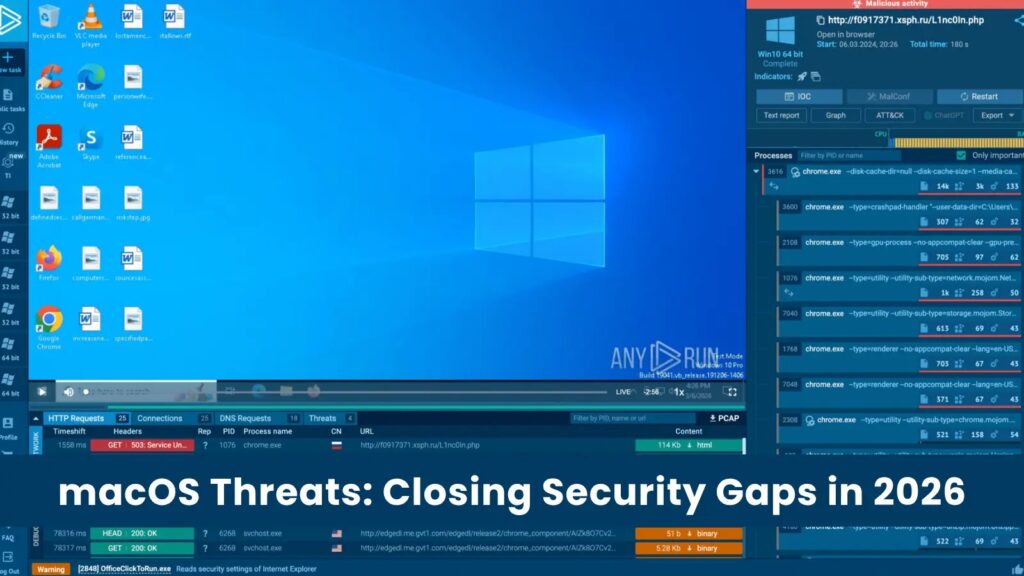
macOS has become a standard part of modern business environments, especially across engineering, product, and leadership teams.
That makes it a growing security concern: when a Mac used by a high-access employee is compromised, it can lead to stolen credentials, exposure of sensitive internal data, unauthorized access to business systems, financial loss, operational disruption, and reputational damage.
So how can companies prevent this? The answer lies in one of the most effective strategies enterprises are already adopting: early detection through proactive analysis of suspicious files and URLs.
Let’s look at how this approach helps reduce business risk and how your team can apply it too.
Why macOS Is Still a Blind Spot for Many SOCs
Many SOC workflows are still optimized for more familiar investigation paths, leaving macOS threats harder to validate early and with confidence.
When suspicious files or URLs involve macOS, teams may need extra steps, separate environments, or manual verification before they can confirm malicious activity.
This leads to:
- slower alert triage
- delayed response decisions
- limited visibility into real macOS threat behavior
- more investigation friction for analysts
- higher risk of missed or late detections
Early Detection of macOS Threats through Proactive Interactive Analysis
Modern SOC teams are increasingly using interactive sandboxes to detect macOS threats earlier and investigate them with more confidence.
This is especially valuable in environments where security teams need to analyze threats across multiple platforms without switching between separate tools.
For instance, ANY.RUN sandbox supports this approach with environments for macOS, Windows, Linux, and Android, helping teams investigate suspicious files and URLs within one workflow.
A good example is Miolab Stealer, a macOS credential stealer analyzed inside the ANY.RUN sandbox.
Check analysis session with Miolab Stealer

The sample displays a fake system authentication prompt designed to closely resemble a legitimate macOS message, making it less likely to raise suspicion. Without a valid password, the malware does not continue its execution chain.

Once authentication succeeds, it gathers system information, searches user directories for files, archives the collected data, and exfiltrates it to a remote server.
Give your team early visibility into deceptive behavior and the context needed to stop macOS threats before they lead to credential theft or data loss. Expand cross-platform visibility
The interactive sandbox reveals this full behavior chain, including deceptive dialogs, AppleScript-based file collection, and outbound data transfer, giving security teams a clearer view of the threat’s intent and potential business impact.

How Early macOS Threat Detection Supports Faster SOC Response
When security teams can investigate macOS threats early, they can make faster and more confident decisions during triage.
Instead of relying on limited indicators or fragmented investigation steps, they gain direct visibility into how a suspicious file or URL behaves and what risk it poses to the business.
This improves operations in several important ways:
- Reduced manual effort for Tier 1 teams: Automated analysis surfaces key behaviors faster, so analysts spend less time piecing together scattered signals or switching between tools.
- Faster, more confident triage decisions: Interactive analysis helps teams observe suspicious behavior more clearly, while automation speeds up the path to evidence.
- Smoother handoff to Tier 2: Auto-generated reports and structured evidence give senior responders the context they need to review escalations and act faster.

- Fewer unnecessary escalations: When Tier 1 can validate more activity independently, only the cases that truly require deeper investigation are passed on.
- Lower analyst fatigue and burnout: Less repetitive manual work and less uncertainty help reduce pressure during high-volume periods.
- Better visibility into real macOS threat behavior: Interactivity helps expose deceptive prompts, credential theft attempts, file collection, and exfiltration that might otherwise stay hidden.
- Stronger protection for high-value users and systems: Faster, clearer analysis helps reduce the risk of compromise affecting sensitive data, internal resources, and business-critical access.
Expand Cross-Platform Threat Visibility Before Gaps Turn into Risk
As enterprise environments grow more complex, security teams need faster visibility into threats across operating systems, including macOS.
Early, interactive analysis helps SOC teams move from uncertainty to evidence faster, reducing investigation delays and helping teams respond with more confidence.
Teams using ANY.RUN’s interactive sandbox are already seeing measurable impact:
- 3× boost in SOC efficiency
- 21 minutes cut from MTTR per case
- 94% of users report faster triage
Strengthen cross-platform threat visibility with faster, evidence-driven investigations that reduce blind spots, speed up response, and help protect business-critical environments.
The post macOS Threats Are the Biggest Security Gap in 2026: How SOC Teams Close It appeared first on Cyber Security News.
Kaynak: Cyber Security News
Yayin Tarihi: 25.03.2026 17:08